The phone rings out twice and then somebody says "hello?" and your mouth does the thing where it starts a sentence it has not finished planning.
You get through it. Sort of. They say "not interested" before you have finished saying what you do, and you say "okay, no worries, thanks" and hang up, and then you sit there for a second.
Then you do not dial the next one for eleven minutes.
You have watched the videos. You know you are supposed to sound confident, build rapport, handle the objection. None of that is a thing you can do at 9:40 on a Tuesday with your heart going and a stranger waiting on the line.
What you needed was the actual sentence. And nobody gave you the actual sentence.
It is not a you problem, and the numbers are not close
Prospeo and Pitchbase call reluctance research, 2026.
Read the third one again. Veterans. People who have done this for six years.
If you assumed the feeling goes away once you get good, it does not entirely. The people who look relaxed on the phone are not people who feel differently to you. They are people who have a system.
And there is one more number that matters more than all three:
DemandNexus objection handling analysis.
Four out of five times, "not interested" is fired before they know what you want. They are not rejecting your offer. They have not heard it.
Which means the call you thought you lost was mostly still there, and you hung up on it.
The one shift that makes the whole thing easier
You are not selling on this call.
A first call has one job: find out who decides, and whether this is even a category they touch. That is the whole thing. If you come away with a name, a title and a direct line, the call succeeded, even if you never spoke to that person, even if they never buy, even if it lasted ninety seconds.
Which is why the opener in this book contains the line "I am not calling to sell you anything today", and why that line works when the ones you have tried did not.
It is not a foot in the door. It is true. You do not know what they buy, how much, from whom, on what terms, or whether they have any budget. Trying to sell before you know any of that is not bold. It is badly organised.
People can hear the difference between a true sentence and a technique. They have heard every technique.
One example, so you can judge the rest
Here is the highest yield question in the book. It is for the moment somebody says "just send it to info@", which is the moment most calls quietly die.
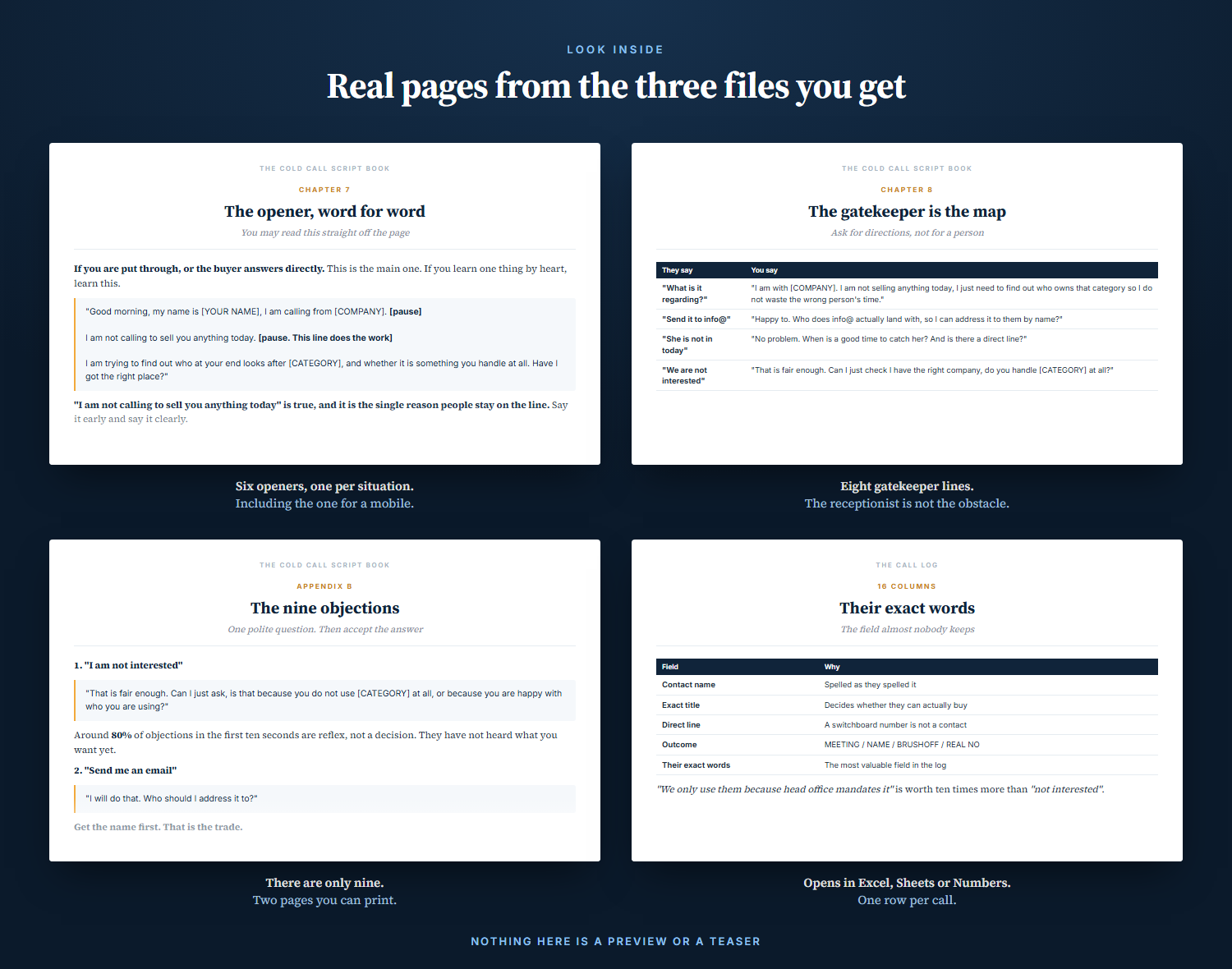
"Happy to. Who does info@ actually land with, so I can address it to them by name?"
It gets answered because it sounds like admin rather than like selling. It is a question about their filing system, not about their colleague, so nobody feels they are giving anything away.
And it converts a dead inbox into a named human, which is the entire object of the call.
There are 41 more like it.
What you get
Counted, not valued
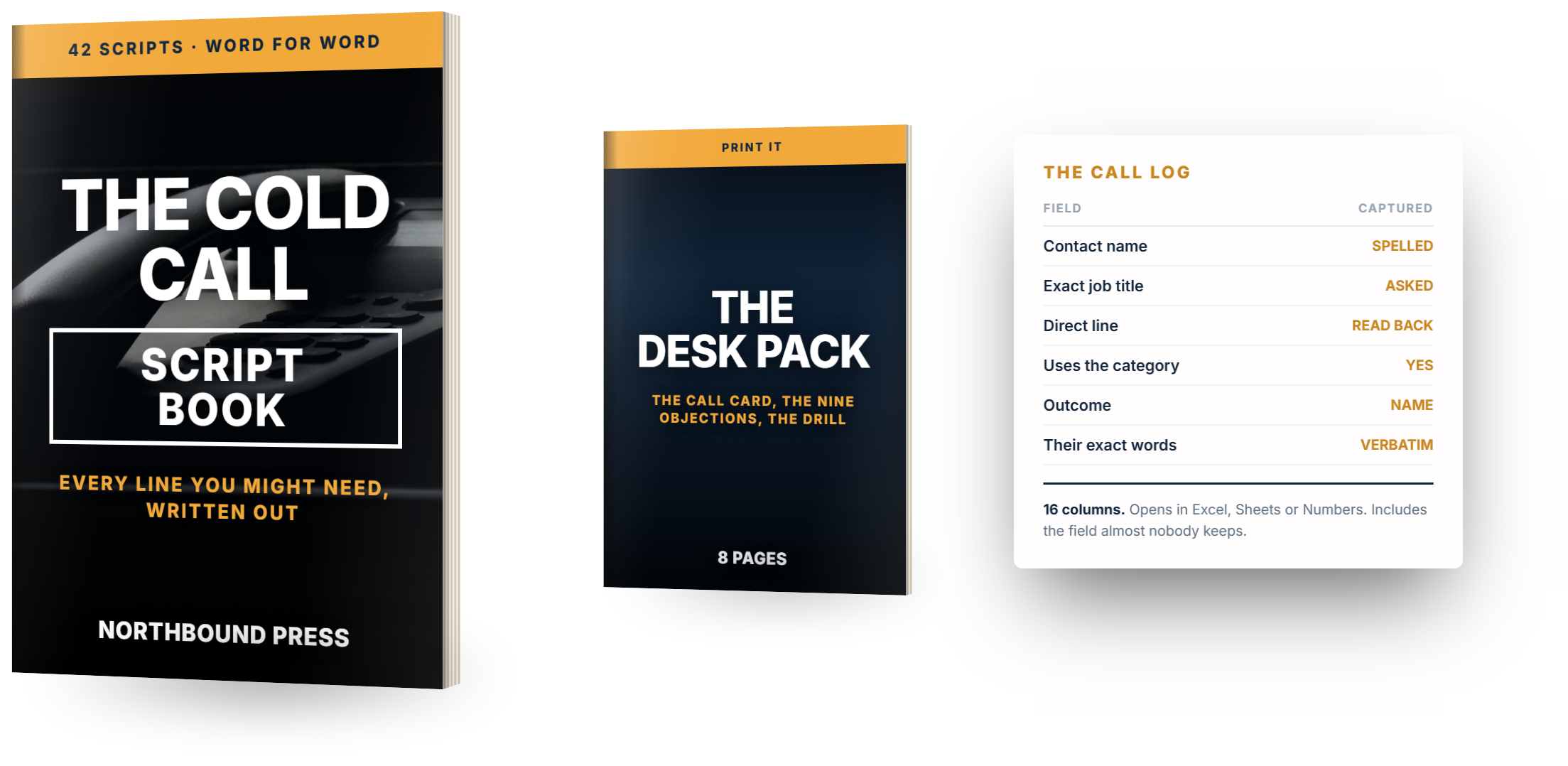
The Cold Call Script Book
the book
65pages
20 chapters, 13,906 words
The Desk Pack
the printable
8pages
call card, objections, drill
The Call Log
the tool
16columns
CSV, one row per call
42 scripts, written out word for word
Openers, gatekeepers, objections, saves, closes and voicemail. Plus 50 openers indexed by situation in Appendix E, and the nine objections with the answers in Appendix B.
All three together, one payment. 29 dollars.
Counts are the contents of the files themselves. No dollar value is placed on any item here.
What is inside, by what it changes
| Chapter | What you stop doing |
|---|---|
| 1 to 4. Before you dial | Burning your best lead on your first ever call, and dialling cold with a dry throat and no warm up |
| 5 to 6. How to talk | Talking too fast, ending statements like questions, and filling the silence after your own question |
| 7. The opener | Improvising the first ten seconds. Six openers, one per situation, including the mobile one |
| 8. The gatekeeper | Treating the one person in the building who knows who does what as an obstacle |
| 9 to 10. Finding the decider | Coming away with a company instead of a name, and asking closed questions that end the conversation |
| 11. Saving a dying call | Hanging up on the 80% that were a reflex, not a decision |
| 12. Brush off or real no | Retiring accounts nobody ever assessed, and chasing ones that will never buy |
| 13. Freezing and bluffing | Guessing at an answer, which is the one genuinely unrecoverable mistake |
| 14. Voicemail | Leaving a pitch that hands them everything they need to decide no without speaking to you |
| 15 to 16. The close | Doing all the hard work and then trailing off without asking for anything |
| 17 to 18. Logging and normal | Measuring dials, and thinking a normal week is a failing one |
| 19 to 20. Where you may call | Assuming the rules where you are calling are the rules where you are sitting |
This is for you if
- You have a list open in one tab and you have been reorganising it for two days, because researching feels like working and dialling does not.
- You know exactly what you should have said, and it arrives about ninety seconds after you hang up. Every time.
- You have been doing this for years and you still take a run up before the first call of the day, and you have never told anyone that.
- You send the email when they say "send me an email", and you log it as progress, and some part of you already knows what it actually was.
- You are fine in a meeting. You are fine on a second call. It is only the first ten seconds with a stranger, and it is only on the phone.
It does not matter much what you sell. The scripts use a bracketed [CATEGORY] because the structure is the part that works. It has been used to call importers, distributors, manufacturers, agencies, procurement teams, restaurant owners and sole traders, in seven countries.
Before you buy, read this
This is a book of words to say. That is all it is.
There is no mindset content, no motivation, no section on belief or energy or becoming the kind of person who loves the phone. If that is what you are after, this will disappoint you and you should not buy it.
It is not a lead list, a dialler or a CRM. It does not find you anybody to call. It is what you say once something else has connected you to a human.
It will not fix a bad list, and I am not going to pretend it will. The published benchmarks are blunt about this: verified direct dials connect far more often than generic data. That gap is data, not dialogue. A perfect script against a bad list loses to an average script against a good one. Chapter 17 tells you to check the list before you rewrite the opener, which is the opposite of what most people do.
And it does not promise you a conversion rate. Anybody who tells you a script converts at a specific number is either selling you something or has never worked a list that was not their own.
What it does is make your calls calmer, shorter, and far more likely to end with a name. Buy it for that. Do not buy it for anything else.
Twenty nine dollars
Average dial to meeting conversion is 2.3 to 2.5%, which is about one meeting for every 40 to 45 dials. Work out what one meeting is worth in your business, then divide twenty nine dollars by it.
For most people reading this, the book costs less than the eleven minutes you did not dial after the last bad call.
Here is exactly what you get for 29 dollars
- The Cold Call Script Book. 65 pages, 20 chapters, 13,906 words
- 42 scripts, written out word for word. Openers, gatekeepers, saves, closes, voicemail
- 50 openers indexed by situation. Appendix E
- The nine objections, with the answers. Appendix B, two pages you can print
- The Desk Pack. 8 pages built to sit beside the phone
- The thirty minute role play drill. Run it with a colleague before you dial
- The call log. 16 column CSV, opens in Excel, Sheets or Numbers
- 30 day refund. Email and say the word refund. No form, no questions
The Cold Call Script Book, 65 pages, PDF
The Desk Pack, 8 pages, built to be printed
The call log, 16 column CSV
Instant download. No app, no login, no subscription, no upsell.
Paid by card through Stripe. We never see your card details.
The refund
Thirty days. Email and say the word refund. There is no form and I will not ask you why.
The honest reason that is safe to offer: if you read chapter 7 and chapter 8 and make ten calls, you will know inside a day whether this works for you. Nobody needs thirty days to find that out. The thirty days is so you do not have to decide today.
Questions
What format is it?
PDF, three files. The book, the Desk Pack and the call log CSV. The download link appears the moment you pay and is emailed to you as well. No app, no account, no login.
Does it work for what I sell?
The scripts are written with a bracketed [CATEGORY] you fill in. They were built for first contact into companies that had never heard of the caller, with no brand and no case studies, which is the hardest version of the job. If it works from there it works from where you are standing. It is business to business throughout. If you are calling consumers at home, this is the wrong book.
I have been in sales for years. Is this too basic?
Possibly. Be honest with yourself about it. What is not basic is Part Four, which is the chapters on saving a dying call and telling a brush off from a real no, and chapter 17 on what to measure. If you already log verbatim quotes and know your names-per-conversation number, you probably do not need this.
Can I read it during an actual call?
Yes, and that is the design. Reading calmly sounds better than improvising anxiously and nobody has ever detected a script read at a normal pace by somebody who understood it. The Desk Pack exists specifically for this, because scrolling a 65 page PDF while a stranger talks is not workable.
Is cold calling even legal where I am?
Chapter 19 covers the landscape and the five questions to get answered before your first dial, including the one most English speakers get wrong, which is that the United Kingdom is stricter for business calls than the United States or Australia. It is a map of what to ask, not legal advice, and it says so. Get your own position confirmed in your own market.
Is there an upsell, a course, or a call?
No. There is one product at one price and nothing behind it. You will get one email with your download and nothing after that unless you reply.
Can I use it for my team?
One copy is one person. If you want it on a call floor, reply to your receipt and ask, and I will sort out a sensible number rather than making you buy eleven copies.
65 page book, 8 page Desk Pack, 16 column call log. Instant PDF.
30 day refund, no questions and no form.
The next call is the one that resets the day.
You may as well have the words in front of you.